CHRISTOPHER VICE, author
Originally published by The State of Design Management Education, Design Management Institute Review, Volume 18, Issue 3 (2007): 75–81. Jul 1, 2007.
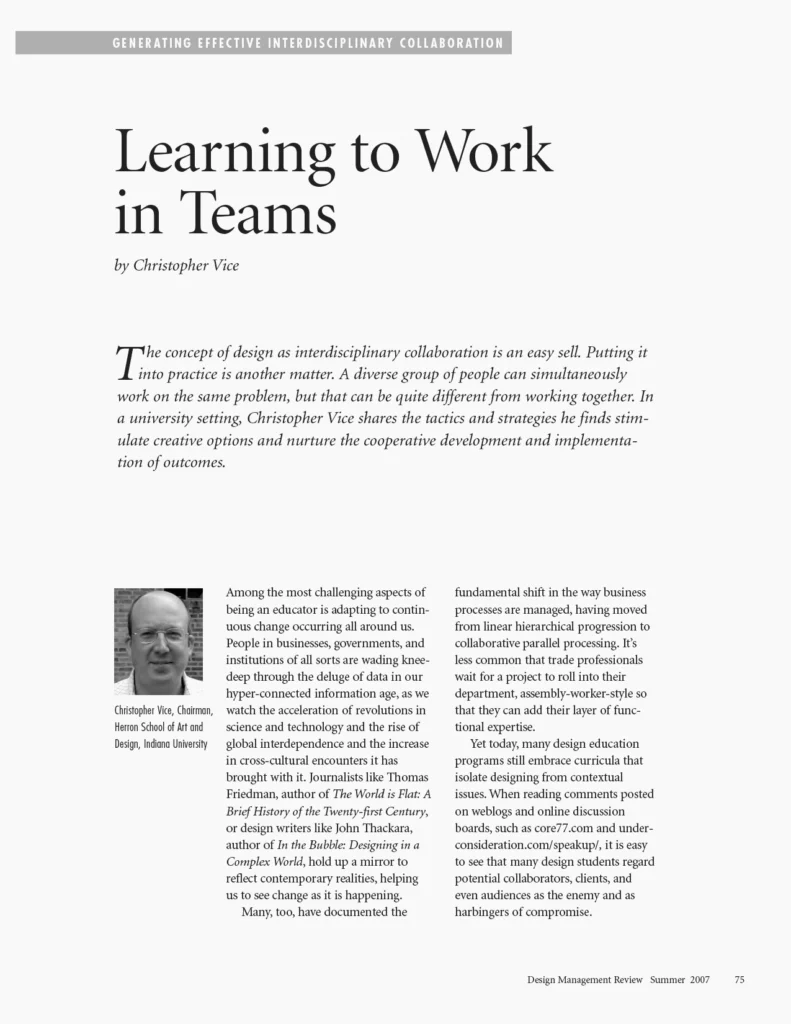
The concept of design as interdisciplinary collaboration is an easy sell. Putting it into practice is another matter. A diverse group of people can simultaneously work on the same problem, but that can be quite different from working together.
In a university setting, Christopher Vice shares the tactics and strategies he finds stimulate creative options and nurture the cooperative development and implementation of outcomes.
EXCERPT
Among the most challenging aspects of being an educator is adapting to continuous change occurring all around us. People in businesses, governments, and institutions of all sorts are wading kneedeep through the deluge of data in our hyper-connected information age, as we watch the acceleration of revolutions in science and technology and the rise of global interdependence and the increase in cross-cultural encounters it has brought with it. Journalists like Thomas Friedman, author of The World is Flat: A Brief History of the Twenty-first Century, or design writers like John Thackara, author of In the Bubble: Designing in a Complex World, hold up a mirror to reflect contemporary realities, helping us to see change as it is happening.
Many, too, have documented the fundamental shift in the way business processes are managed, having moved from linear hierarchical progression to collaborative parallel processing. It’s less common that trade professionals wait for a project to roll into their department, assembly-worker-style so that they can add their layer of functional expertise.
READ MORE • Article PDF in new window